Trump administration appeals court-ordered limits on tear gas use near Portland’s ICE facility protests
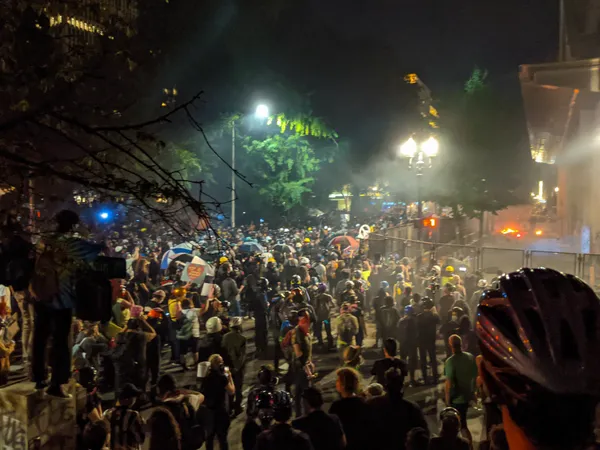
Appeal filed after federal court restricts chemical munitions during demonstrations in South Waterfront
The Trump administration has appealed a federal judge’s order that sharply limits when federal officers may deploy tear gas and other crowd-control munitions during protests outside the U.S. Immigration and Customs Enforcement (ICE) facility in Portland’s South Waterfront.
The appeal follows a series of court actions in early 2026 that placed new constraints on federal tactics near the building after repeated demonstrations tied to immigration enforcement and a broader national surge in federal immigration operations.
What the court orders do
Two parallel cases have produced distinct but related limits on the use of chemical agents and projectiles near the ICE facility.
In one case, a federal judge issued emergency restrictions—initially as a temporary restraining order—preventing federal officers from using chemical or projectile munitions against people who do not pose an imminent threat of physical harm. The limitations also addressed the use of force against individuals who are merely trespassing or refusing to disperse.
In a separate case brought by residents living near the facility, a federal judge ordered even narrower circumstances for chemical munitions, tying permissible use to situations in which officers reasonably fear for their lives. That order is the subject of the administration’s appeal.
The court record in the protest-focused lawsuit includes sworn testimony from demonstrators and freelance journalists describing exposure to tear gas and other munitions during protests near the ICE building. In court filings and hearings, the federal government has defended the use of crowd-control tools as necessary to protect federal property, remove trespassers, and respond to violent or obstructive activity.
Key dates and how the dispute escalated
The legal dispute accelerated after a large march arrived at the ICE facility on January 31, 2026, when federal officers used crowd-control munitions, including tear gas, during clashes near the building. In the days that followed, emergency court proceedings led to a temporary restraining order issued on February 3, 2026. That order was later extended as the court scheduled and prepared for further hearings on longer-term restrictions.
On March 9, 2026, a federal judge issued a preliminary injunction in the protest-focused case after an evidentiary hearing, continuing limits on chemical and projectile munitions unless an imminent threat standard is met.
What the appeal means going forward
An appeal does not automatically erase the restrictions; the practical effect depends on whether an appellate court grants a stay or otherwise modifies the lower-court order while the appeal proceeds. The litigation is expected to continue alongside ongoing protests and heightened scrutiny over federal crowd-control tactics near the ICE building, where residential housing, public streets, and federal property intersect in a dense area of the city.
The central legal question in both cases is how federal authorities may protect facilities and personnel while complying with constitutional protections for speech and assembly and limits on the use of force in crowd settings.
Further hearings and appellate rulings will determine whether the restrictions remain temporary, are broadened, narrowed, or become longer-lasting limits on federal operations at and around the Portland ICE facility.