PBOT responds to multiple Portland-area landslides, triggering road closures, inspections, and ongoing slope stabilization work
Multiple slides disrupt travel as crews prioritize safety and access
Transportation officials in Portland have responded to a series of landslides and rockfall events that have periodically forced road closures, lane restrictions, and emergency maintenance in hillside corridors. The incidents underscore how saturated soils and unstable slopes can quickly affect key connections through the West Hills and other elevated terrain during the region’s wet season.
In one widely disruptive episode, a landslide prompted the closure of NW Cornell Road between NW Skyline Boulevard and NW Thompson Road, while a separate slide reduced NW Thompson Road to a single lane between NW Pinnacle Drive and NW Miller Road. The closures were paired with daylight engineering inspections to evaluate hillside stability and determine whether maintenance crews could safely remove debris and address slope conditions.
How PBOT manages landslide response on city streets
For landslides that affect city-maintained streets, PBOT functions as the lead bureau for response activities. Field actions typically follow a sequence: closing the affected segment, conducting preliminary checks, scheduling engineering inspections when visibility is best, and then clearing debris if the site is deemed safe. Officials have noted that slides can undermine adjacent hillside material, increasing the risk of additional movement even after the initial failure.
- Immediate closures and traffic control to keep travelers out of unstable areas
- Daylight inspections to assess slope stability and worker safety
- Debris removal and, where needed, targeted stabilization actions
- Ongoing monitoring through the rainy season when conditions can rapidly change
Rockfall on SW Tichner Drive shows the scale and complexity of mitigation
A separate event on SW Tichner Drive illustrated the operational challenges of larger slope failures. On March 29, 2025, hundreds of cubic yards of rocky material broke loose from a steep rock face above the roadway. While much of the debris landed in a nearby sand storage area, rock spilled onto the street and prompted a full closure of both vehicle lanes due to concerns that additional material could fall without warning.
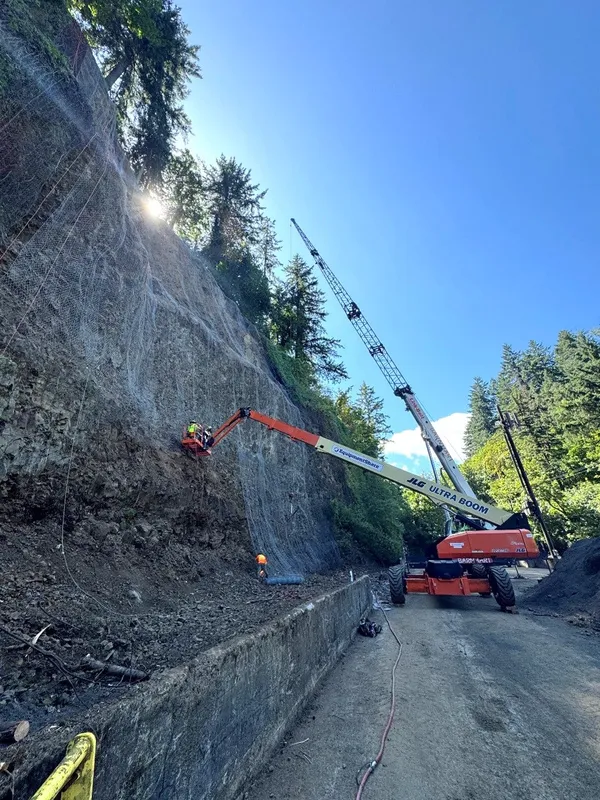
The response evolved into a multi-phase mitigation project, including scaling loose rock, removing older netting, hauling thousands of cubic yards of debris, and installing a draped cable mesh system intended to reduce future rockfall onto SW Tichner Drive and W Burnside Road. The street reopened to vehicle traffic on August 20, 2025, and PBOT has continued to monitor the area through subsequent rainy seasons while planning additional repairs to damaged protective infrastructure at the base of the slope.
Landslides and rockfall can remain active hazards after the first collapse, requiring repeated inspections, controlled access, and seasonal monitoring.
What to watch for during periods of heavy rain
In Portland’s hillside neighborhoods, landslide risk can change quickly with prolonged rainfall. Road users should expect that closures and detours may be implemented on short notice, particularly on steep routes where debris can block lanes and where hillside movement can compromise roadway edges, retaining features, or drainage systems.
PBOT has advised drivers and other travelers to follow posted closures and use alternate routes when slides occur, as reopening timelines depend on inspection results and safe working conditions for crews.