New nighttime lighting reveals Portland waterfront cherry blossoms’ history and the Japanese American Historical Plaza’s origins
A seasonal landmark draws new attention after dark
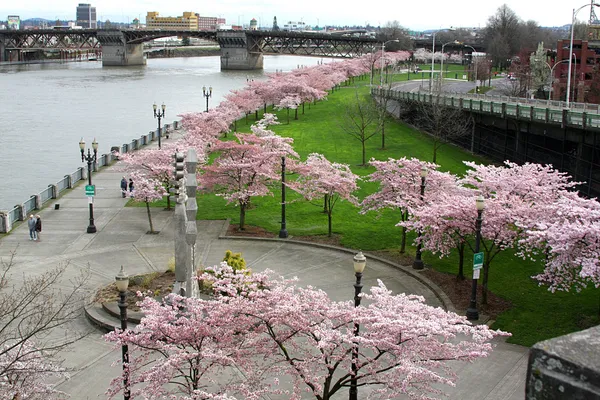
Each spring, the row of cherry trees at Tom McCall Waterfront Park becomes one of Portland’s most photographed landscapes. In late March 2026, nighttime illumination added a new dimension to that familiar scene, turning the waterfront canopy into an after-hours viewing destination and expanding when people experience the bloom.
The trees are concentrated around the Japanese American Historical Plaza at the park’s north end, a site created to commemorate Portland’s Japanese American community and the neighborhood that once stood nearby. The plaza sits within a broader downtown riverfront park that stretches along the Willamette River and regularly hosts large public gatherings.
Why the waterfront blossoms are there
Portland’s waterfront cherry trees are closely tied to the Japanese American Historical Plaza’s development and dedication. The plaza’s creation involved local civic partners and Japanese American community organizations, and the cherry trees became part of the springtime identity of the site.
Public historical materials associated with the plaza describe how community leadership shaped the memorial landscape and its educational purpose. In that context, the annual bloom functions not only as a natural event but also as a recurring moment that draws visitors into a place built to carry memory and interpretation.
What the new lighting changes—and what it does not
Night lighting does not alter bloom timing, which still depends on weather patterns that can shift peak viewing by days or weeks. What illumination changes is access: it extends the viewing window beyond daylight hours and reframes the trees as a nighttime feature rather than a strictly daytime attraction.
For visitors, the shift creates a different visual experience that emphasizes color gradients, branch structure and density, and silhouettes against the river corridor—features that are less pronounced in typical midday viewing. For the city, it adds a new layer to how a highly trafficked public space is used during a short and crowded season.
- Location: Japanese American Historical Plaza area at Tom McCall Waterfront Park
- Season: late March blooms are typical, with variability tied to temperature and rainfall
- Experience: lighting enables nighttime viewing and changes how crowds distribute across the day
Community programming alongside the bloom
Cherry blossom season on the waterfront increasingly overlaps with organized public activities focused on Japanese American history and cultural visibility. In March 2026, a new Portland event was introduced during the bloom period to recognize the legacy of Henry Sakamoto, connecting springtime visitation with local historical remembrance and community-based programming.
The waterfront bloom is a seasonal draw, but the setting is also a memorial landscape designed to teach and commemorate.
What to watch next
As nighttime viewing grows, key questions for future seasons include how lighting is scheduled, how crowd impacts are managed in a dense downtown park corridor, and how stewardship messaging—especially about protecting branches and blossoms—keeps pace with rising visitation.