How Portland renamed Union Avenue for Martin Luther King Jr. and later installed The Dream statue
A street name change that became a citywide debate
Portland’s Northeast Martin Luther King Jr. Boulevard is widely recognized today as a major north-south corridor and a symbolic civic marker. Its current name, however, dates to a relatively recent and contested decision.
On April 20, 1989, Portland’s City Council adopted an ordinance renaming Union Avenue as Martin Luther King Jr. Boulevard. The change came more than two decades after similar renamings began in other U.S. cities following King’s assassination in 1968. In Portland, the effort accelerated in the late 1980s, led by a coalition of community figures that included media, faith, civic and business leaders. Organizers gathered thousands of signatures and evaluated multiple candidate streets before Union Avenue emerged as the final choice.
Union Avenue itself had earlier names. In the late 19th century it was known as Margueretta Avenue, and after the 1891 consolidation of Portland with Albina and East Portland it took the name “Union Avenue,” tied to the creation of a single city government. By the 1930s, the corridor had been widened and became a transit route, strengthening its role as a commercial and transportation spine.
Legal challenges and the Oregon Supreme Court decision
The 1989 renaming triggered significant opposition. A campaign formed seeking to reverse the decision through the ballot, arguing that the change should be subject to a vote. That effort produced a legal dispute that reached the Oregon Supreme Court.
In March 1990, the court addressed whether the proposed initiative could be used to undo the city’s action. The ruling concluded the renaming decision was administrative rather than legislative, meaning it was not subject to change through the initiative process in the manner proposed. The outcome left the boulevard’s new name in place.
From street sign to public monument: “The Dream”
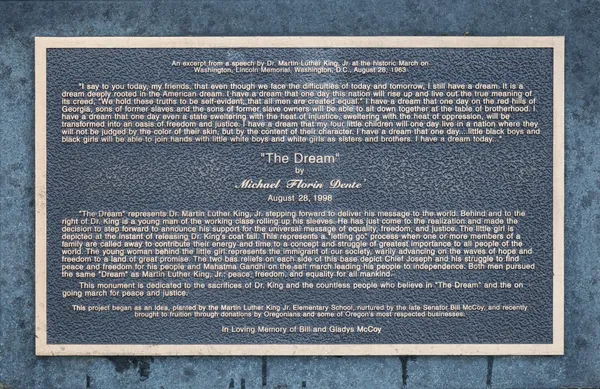
Nearly a decade later, the boulevard gained a prominent piece of civic art at a key intersection. On August 28, 1998, an outdoor bronze memorial sculpture titled “The Dream” was dedicated outside the Oregon Convention Center at Northeast Martin Luther King Jr. Boulevard and Northeast Holladay Street. The dedication date marked the 35th anniversary of King’s “I Have a Dream” speech.
Created by sculptor Michael Florin Dente, the installation depicts King alongside three additional figures presented as allegorical representations. The work’s placement—at a high-traffic gateway to the convention center and the Rose Quarter area—made it one of the most visible monuments to King in Oregon.
- April 20, 1989: Portland City Council ordinance renames Union Avenue to Martin Luther King Jr. Boulevard.
- March 21, 1990: Oregon Supreme Court decision addresses the attempted ballot reversal, leaving the rename intact.
- August 28, 1998: “The Dream” bronze memorial is dedicated outside the Oregon Convention Center.
From 1989’s council action to 1990’s court ruling and the 1998 dedication, the boulevard’s modern identity was shaped through both politics and public memory.