How Portland, Maine’s Valentine’s Day Phantom turned overnight paper hearts into a decades-long city tradition
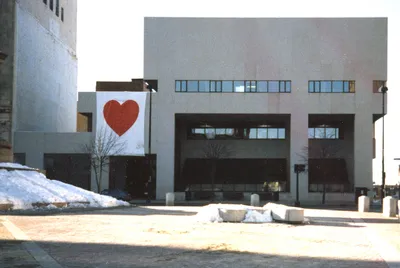
A pre-dawn transformation that returns every February
In Portland, Maine, downtown storefronts and well-known landmarks have repeatedly appeared altered on Valentine’s Day morning: windows and doors covered with red paper hearts, and in some years larger heart banners and flags placed high above streets and waterfront sites. The decorations typically arrive overnight, creating a citywide reveal that has become part of Portland’s seasonal calendar.
The effort has long been attributed to an anonymous organizer and a small group of helpers, commonly referred to as the Valentine’s Day “Phantom” or “Bandit.” The tradition is documented in photographs spanning decades, showing the hearts appearing across different eras in the city’s business districts and public spaces.
Origins in the 1970s and a ritual that endured
Archival images and local reporting place the tradition’s beginnings in the mid-1970s, with the hearts returning annually and expanding over time. By the late 1970s and into the 1990s and 2000s, photographs show hearts taped in rows across shop windows and entrances—simple materials deployed at scale, often along prominent downtown corridors.
The method has remained consistent: paper hearts placed where pedestrians will encounter them throughout the day. While the decorations are not permanent, their visibility and repetition have made the annual appearance a recognizable marker of Valentine’s Day in the city.
A mystery partially resolved in 2023
For years, the identities behind the operation were intentionally kept private, adding to the ritual’s mythology. That secrecy eased in April 2023, when the family of Kevin Fahrman of Falmouth disclosed that he had been a central figure in sustaining and organizing the annual effort for decades. He died in April 2023 at age 67.
Accounts of the tradition describe it as collaborative, with volunteers helping to place hearts and, in some years, larger installations. The group’s discretion—combined with the logistical challenge of decorating highly visible locations without public announcement—helped keep individual names out of view for much of the tradition’s history.
Continuity after Fahrman’s death
The annual decorations continued after 2023, with volunteers carrying the work forward. Recent Valentine’s Day coverage has described hundreds of smaller hearts appearing across downtown and noted that weather conditions can influence whether larger banners or flags are installed in a given year.
What the long-running photo record shows
- Hearts appearing across multiple decades, including the late 1970s, 1990s, and 2000s.
- Repeated use of storefront windows and doors as primary canvases.
- Periodic expansion to larger landmarks and elevated placements, when conditions allow.
- A sustained, volunteer-driven operation that persists despite leadership changes.
Across nearly 50 years of Valentine’s Days, the hearts have served as a consistent visual signature—brief, ubiquitous, and renewed each year before most of the city wakes.